

Highland Park - Viking Whisky
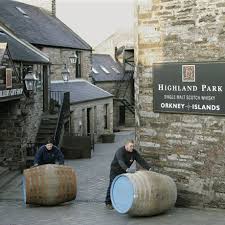
Highland Park comes from a distinct and remote part of Scotland: the fantastically beautiful Orkney islands, which are situated some 16 km to the north of John O'Groats, the most northerly point of the Scottish mainland. Orkney is an island group comprising 70 islands of which only 20 are currently inhabited. What differentiates Orkney, as well as the neighbouring Shetland Islands, which lie some 117 km or 110 miles yet further to the north, are some 600 years plus of Viking past and heritage. In fact, both island groups didn't become part of Scotland until 1472 after being transferred over to the Scottish crown by the Kalmar Union (the union of Norway, Sweden and Denmark that existed from 1397 to 1523) as a dowery on the marriage of James III of Scotland to Margaret of Denmark.
The Orkneys were settled first by people from Northwestern Norway and then eventually from regions further south in Norway and DNA evidence goes to suggest that the first Norse settlers blended with the existing Pictish population, which had inhabited the islands since the bronze age.
The ”Orkneyjar” were (and in a way now remain) a nationality within a nation, as Orkney was no less a Viking kingdom than Iceland, Nordic Greenland or the Faroe Islands. The islands even have their own saga: the Orkneyinga Saga, albeit it seems to have originated over the sea in Iceland. Orkney had its own language, Norn, (also spoken in the Shetlands in a different dialect) the last native speaker of which, Walter Southerland, died in 1850. The language shared much of its grammar and vocabulary with the Old West Norse languages such as Norwegian, Icelandic, Faroese and Greenlandic. We can more or less decipher the language from runic inscriptions that exist on runestones in various places in Orkney and then comparing it to other Nordic languages, notably Faroese.
The Orkneyinga Saga tells us that the Orkneys served as a base for pirate raids on the coasts of both Norway and of Scotland. The raids caused Norwegian king Harald Hårfagre to annex the Northern Isles in 875. Although we think of Viking Scotland as principally being Orkney and Shetland, at times, the Viking kingdom actually also extended past the tip of the northern Scottish mainland and into Caithness and Sutherland.
The islands were fully Christianised by Olav Tryggvason in 995 but, as Norway spent much of the middle ages in a state of near-perpetual civil war, Scottish earls supplanted Norwegian ones when in 1231 when the bloodline of earls (known as jarls) which had been established by Harald Hårfagre came to an end. In that same year, the earldom of Caithness (then also a Scandinavian possession) was inherited by Magnus, son of the Mormaer of Angus. Thus the Orkneys’ earls actually became Scottish, albeit under Norse suzerainty until the 1472 transfer to Scottish rule and the islands remain an earldom to this very day.
Orkney and the warm and welcoming Orcadians offer the visitor an a treasure trove of things to see and do with gorgeous medieval cathedrals, renaissance palaces, bronze age sites, breathtakingly wild and spectacular scenery and more. It’s a part of Scotland with a unique and different history and whisky also figures into this history, as Highland Park is a special Orkney institution.
There are two remaining distilleries still producing whisky on Orkney: Highland Park and Scapa. Highland Park originates in the early 19th century when it was one of two principal Orkney labels, the other being the extinct brand Stromness, and Scapa dates from 1885.
Highland Park distillery in Kirkwall, the Orkney’s capital, was, according to the legend, founded by a butcher by the name of Magnus Eunson (”Mansie” to his friends!) Eunson. Eunson was also a verger (a beadle in Scotland) and lay preacher but also a notorious nighttime bootlegger and smuggler who began distilling in 1798 on common land in Kirkwall, now the site of the current Highland Park distillery. The land was in the High Park area, so on high lying land and the name of the company derives from this as it is obviously an island whisky and not a Highland one. This was a lucrative sideline for Eunson, as the big money for him seemed to have been in gin and brandy smuggling!
He chose the site on Mill Street because it has a superb water source: the Cattie Maggie’s Spring! Smuggling was far from rare at the time. There were many controls, high duties and in the case of the Orkneys, it was still technically illegal for Orcadians to export their whisky to other parts of Scotland. To give an idea of how widespread and how lucrative and accepted smuggling was: the provost or mayor of Kirkwall was involved, as was the most senior naval officer in Orkney! Eunson used to hide full casks of the whisky beneath the church pulpit! There’s an anecdote about Mansie which appears in whisky traveller and connoisseur Alfred Barnard’s 1887 book Whisky Distilleries of the United Kingdom where he narrowly avoids being hauled up during a raid on the church:
“Hearing that the Church was to be searched for whisky by a new party of excisemen, Eunson had all the kegs removed to his house, placed in the middle of an empty room and covered with a clean white cloth. As the officers approached after their unsuccessful search in the church, Eunson gathered all his people round the whisky, which, with its covering of white, under which a coffin lid had been placed, looked like a bier. Eunson knelt at the head with the Bible in his hand and the others with their psalm books. As the door opened they set up a wail for the dead, and Eunson made a sign to the officers that it was a death and one of the attendants
whispered “smallpox”. Immediately the officer and his men made off as fast as they could and left the smuggler for some time in peace.” (!)
In any event, Eunson’s luck ran out one day and he was eventually caught and arrested by a certain excise officer by the name of John Robertson (remember that name!) for smuggling four packs of untaxed salt and one pack of whisky in 1813, although there’s some dispute as to whether he was actually charged for the offence. Whether he was charged or not, Eunson certainly lost his position as a beadle. There are a whole plethora of Eunson stories that mark him out as the Wily Coyote of the illicit distilling and smuggling scene of 18th and 19th century Orkney!
Eunson had a likely accomplice in the person of William Traill who opened a licensed brewery and distillery in Mill Street in Kirkwall in 1807. It’s here that things get a bit murky, as it looks as if Mill Street might conceivably have acted as the original distillery until the existing Highland Park distillery site was opened in 1818.
In 1816 a syndicate of new owners, including Eunson’s arresting excise officer of three years earlier, John Robertson and Robert Pringle, another exciseman, took control of the operation as a result of purchasing the entire Highland Park estate.
It became possible to legally distil and export whisky from Orkney only after 1823, a year after George IV’s visit and at a time when whisky tariffs were effectively halved. Distilleries all over Scotland began to apply for licenses at that time.
The other oft-mentioned Highland Park founder is the farmer David Robertson. Whisky making is a complex and multifaceted task and, of course, naming the founders of something the was unregistered and illicit is difficult for obvious reasons but suffice to say it looks as if Traill, Robertson and Eunson were possibly partners at a time where a lot of whisky production was run by syndicates. Eunson’s contribution may well have been the special formula which he transplanted from distilling at the site on Holm Road (now the site of the current Highland Park distillery), to Mill Street and thence back to Holm Road in 1818, the year when businessman and farmer Robert Borwick and son-in-law John Robertson become co-founders, although they did not take full control of the distillery from Robert Mackay, who had run Highland Park for just one year, until 1826.
Robertson remained a partner only until 1830 when he sold the interest to back to Borwick and Highland Park remained in the Borwick family until 1868 when it was acquired by William Stuart and incorporated into William Stuart, Stuart and Grant in 1878.
Grant sold the company to Highland Distillers in 1937 and they remained the sole owner until Highland Distillers were incorporated into the Edrington Group in November 1999. Thus Edrington brought not only Highland Park into its stable but also The Famous Grouse as well as The Macallan label. Famous Grouse is a blend that still makes use of a large proportion of the distilling at Highland Park as, despite the remoteness of Orkney, Highland Park is regarded as one of the ”top dressings” available for to blended brand.
It was only in 1979 that Highland Distillers decided to change the emphasis at Highland Park towards the distillation of single malts, so it was not really until the 1970s that Highland Park started to make a name for itself per se.
The quality is largely down to Orkney’s distinctive peat which has a very long burn and which gives off a beautiful smokey, mossy and heathery aroma , arising from the fact that Orcadian peat is derived entirely from sphagnum moss and heather, as the local landscape is treeless. Each April, the peat is actually hand cut by shovel and then dried out over the summer. Barley is added to the fired peat and you get magic: a slightly spicy, citrusy, lightly smokey and complex drink with the aforementioned mossy and heathery overtones. The malt is actually turned manually every few hours for best effect.
The casking is a long process whereby Highland Park actually choose and cut the oak in a reminiscent of the way the Vikings made their longships: the casks are shipped to Jerez, house sherry for two years, are emptied and then are brought over to the distillery to be be filled with whisky which matures in the cool but remarkable temperate climate, protected as it is by the Gulf Stream.
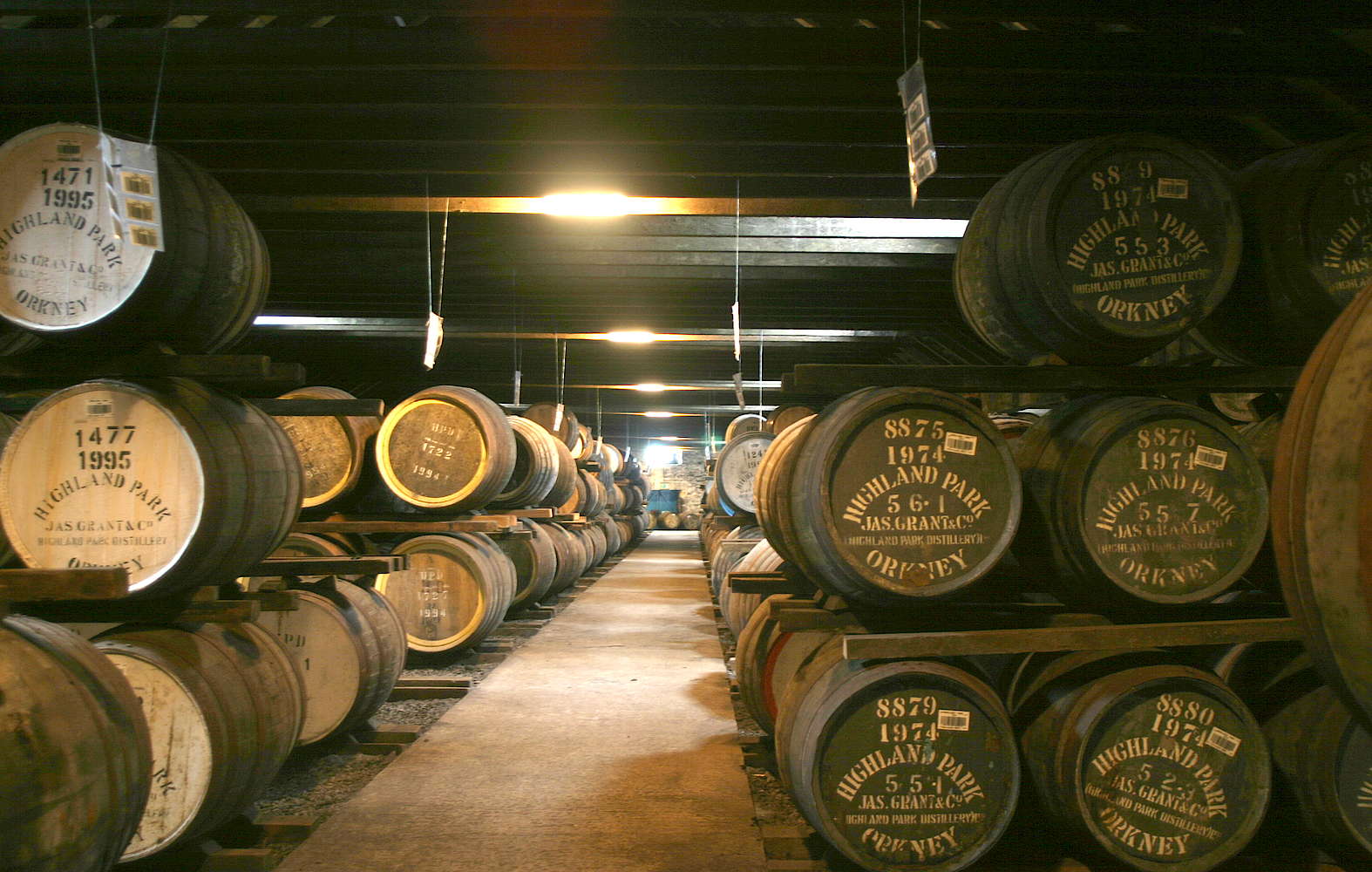
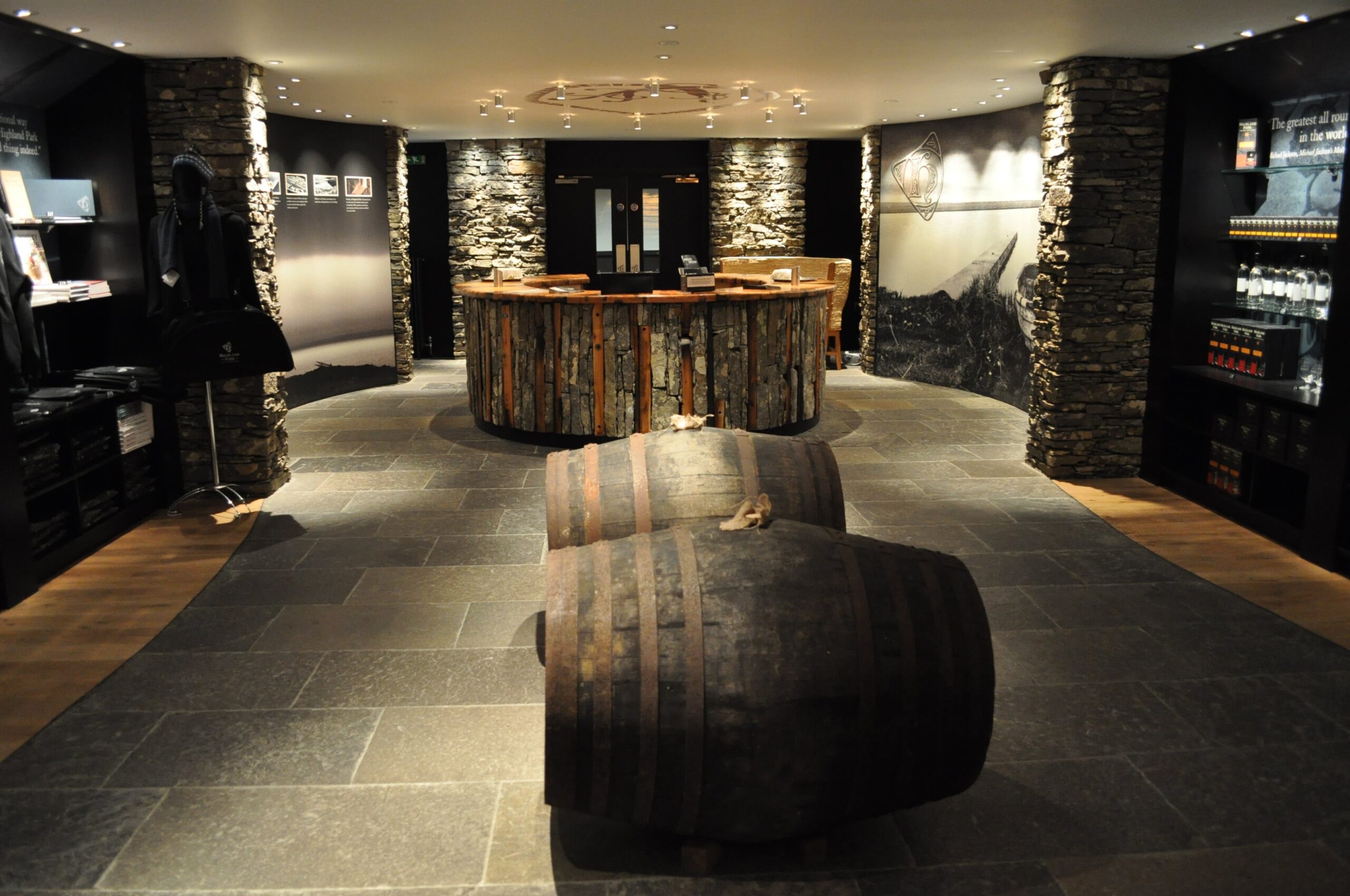
This is one of the best respected whiskies anywhere in the world and it is vaunted by whisky critics and writers to the extent that whisky connoisseur Michael Jackson declared Highland Park‘s Old Viking Honour “The greatest all-rounder in the world of malt whisky” in his book ”Jackson’s Malt Whisky Companion”.
Jackson isn’t the only one to rate Highland Park: its 25 year old single malt scored an unmatched 100 out of 100 at the Ultimate Spirits Challenge held in New York in 2013.
Highland Park, as well as having a colourful and distinct history, is marked out by its almost fathomless depth, acute complexity and sophistication. It’s a singularly aromatic and mossy blend with just a hint of citrus and manuka honey: truly one of the great whiskies, something to which its numerous accolades more than aptly attest.