

Islay Whisky
The Inner Hebrides constitute a large archipelago off the western coast of Scotland.
Together, the islands have a combined area of about 4,130 km2 (1,594 sq miles), and support a tiny of population of some 20,000, spread between some 35 inhabited islands of the total 79. Islay is the southernmost of the Hebrides, situated only around 40 km from the northern coastline of Northern Ireland. It’s very remote and is a full 5-6 hours’ drive from Glasgow, including the ferry crossings.
Islay itself is about the size of Malta but is home to a population of scarcely 3,000 people. It’s four largest settlements are Bowmore, Port Ellen (the only two ‘’towns’’ on the island), the villages of Port Charlotte and Portahaven, plus there are a few smaller hamlets.
Islay has approximately 8,000 years of known human habitation with numerous artifacts having been excavated from the Mesolithic era. It has a definite Viking Heritage and was settled also by the Celts who migrated to the area from many parts of Europe, but the most crucial settlement, one which affects it until the very present, was one that came up the very short distance from Ireland.
In the 300’s and 400’s AD Irish clans migrated across the North Channel from Ireland to Scotland. They formed the four ‘’kindreds’’ or dynasties of the Dai Riata which stretched from the northern part of Ireland (County Antrim) Northern Ireland into historic Argyllshire. That Gaelic heritage is still key and to this day around 25% of Islay’s population remains Gaelic speaking and Islay residents are known as Ileach. Here also lie the origins of whiskey making in the Hebrides with Islay being particularly important in this regard.
Whisky has deep, deep roots. which are close to 1000 years old, on Islay. It was thought to have been brought over from Ireland by monks in the early 1300’s. There could be no imaginable better location.
For one, there are copious amounts of peat. The water in the sheltered sea lochs and the rivers is super-pure and, above all, the area is extremely remote and thus ideal for illegal distilling.
The other crucial factor was that a staple crop in the area was bere, a forerunner of barley. It was not until the late 18th century that professional commercial production began.
The birth of an important commercial distilling industry on the island was due in no small part of the local landowner, Walter Campbell of Shawfield. Walter was the grandson of the Member of Parliament, Daniel Campbell and the story of how Walter brought the whisky industry to Islay is an intriguing one.
It begins in 1725, some 18 years after the Union of the English and Scottish Parliaments. The Westminster Government decided to raise the level of the infamous malt tax in Scotland. A mob came together in Glasgow to forcibly prevent customs officers from upholding the tax and they torched mansion of Daniel Campbell of Shawfield, an MP who had been a supporter of the legislation.
The riot was put down by troops and in the chaos, 9 rioters were killed and 17 wounded. Campbell used the compensation he received to purchase Islay. Walter, his grandson, established the town of Bowmore. He was an idealist and a paternalist and he worked hard to diversify of the island’s poor agricultural economy by encouraging the development of fishing, mining and linen-production.
The whisky production aspect was also important as it would facilitate the commercial production of barley. Things didn’t run altogether smoothly for Campbell, though: Campbell was given the duty to collect excise duties on Islay from distillers and he would make over a stipend to the government each year. This responsibility was then known as the ‘farming’ of excise duties.
In 1795, at a time when the barley crop failed, the government instituted a blanket prohibition on distilling.
Campbell was mandated by the government to confiscate and store a minimum of 90 whisky stills belonging to his tenants. At the same time he relinquished his right to excise farm, so that the Ileach would from then on have to submit their own excise duties directly to the government once the ban was over. The islanders realised that the cat would now be away and that the mice could then play.
They invited over a band of tinkers from Ireland who brought over with them an assortment of boilers and cauldrons to use as
stills. The prohibition on distilling lasted until 1799 and then not one single party on Islay either registered for a license with Scottish Excise Board nor made an excise payment. The industry had gone underground again. Although licensed premises began appearing from the late 18th century, illicit production remained rife throughout the 18th and 19th century.
The government tried to put it down with excise boats, also stationing teams of excise men on the island. It was a constant cat and mouse game, as the smuggling ran in all directions, and the locals would often band together to fight off the excise men, so violence was regularly par for the course.
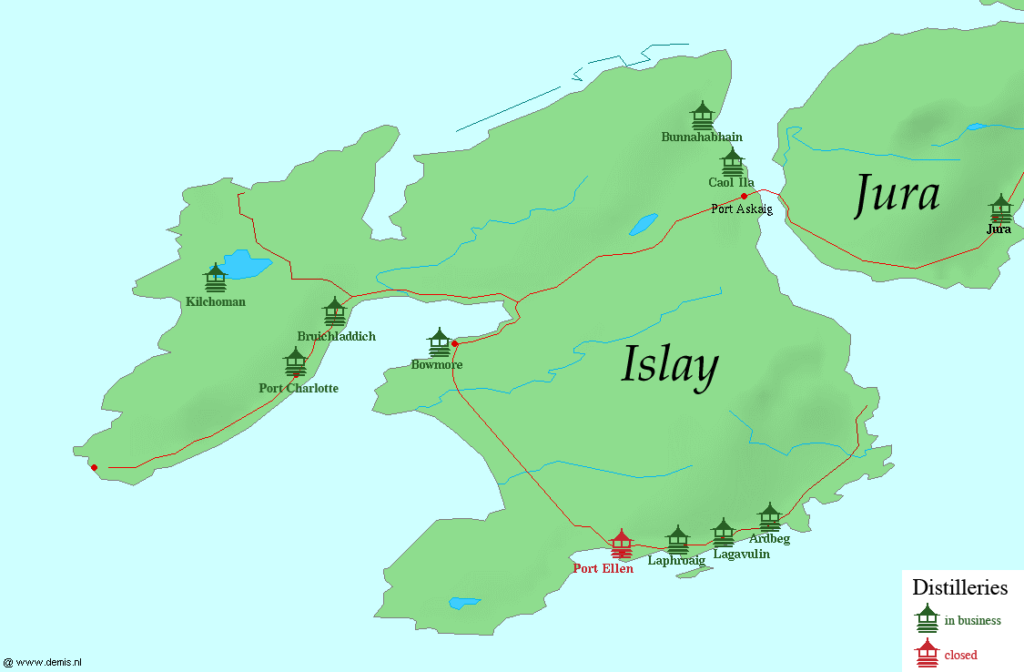
There are currently nine, shortly to be 10, operating distilleries on the island. Of these, four or roughly in the south coast of the island and 6 are in the north.
Bowmore was the first recorded distillery on the Islay, founded officially in 1779 although there is evidence that the founder and owner, David Simpson, started distilling maybe about a decade earlier than that, or at some point after he purchased the land in 1766. It takes it name from its home town, Islay’s largest settlement.
Distilling actually began many years earlier at Lagavulin which is situated in the eponymous village on the south east coast of the island. However, this was another illicit operation and Lagavulin only started operating formally as a company in 1816.
Close by Lagavulin (about one mile or 3 minute’s drive to the west) is the hamlet of Laphroaig which began operations in 1815.
Roughly equidistant in the other direction from Lagavulin is Ardbeg distillery (so about a mile to the east) which has been producing whisky since 1798, and began legal commercial operations in 1815.
The fourth distillery on the south coast of Islay is Port Ellen which closed in 1983, although at the time of writing, a revived Port Ellen is due to open in 2023. The ambitious project is financed by Diageo and, so, when the facility opens in 2023, a vaunted brand will reenter production after a 40 year absence.
These south coast distilleries are collectively known as the Kildalton distilleries, Generally the whiskies are more full-bodied and saltier than those produced elsewhere on the island.
Ardnahoe, which was established in 2018, is the most recently opened distillery on Islay. It’s one of the three distilleries on the east coast of the island, the others being Bunnahabhain, 1.6 miles to its north and Caol Ila, just under 3 miles to the south of Ardnahoe, in Port Askaig.
These northern distilleries offer a product that is as dry as those from the south of the island but it is nowhere near as peaty.
The western distilleries are Bruichladdich and Port Charlotte which border Laggan bay on Loch Indaal, and Kilchoman, which looks out westward over the Atlantic coastline.
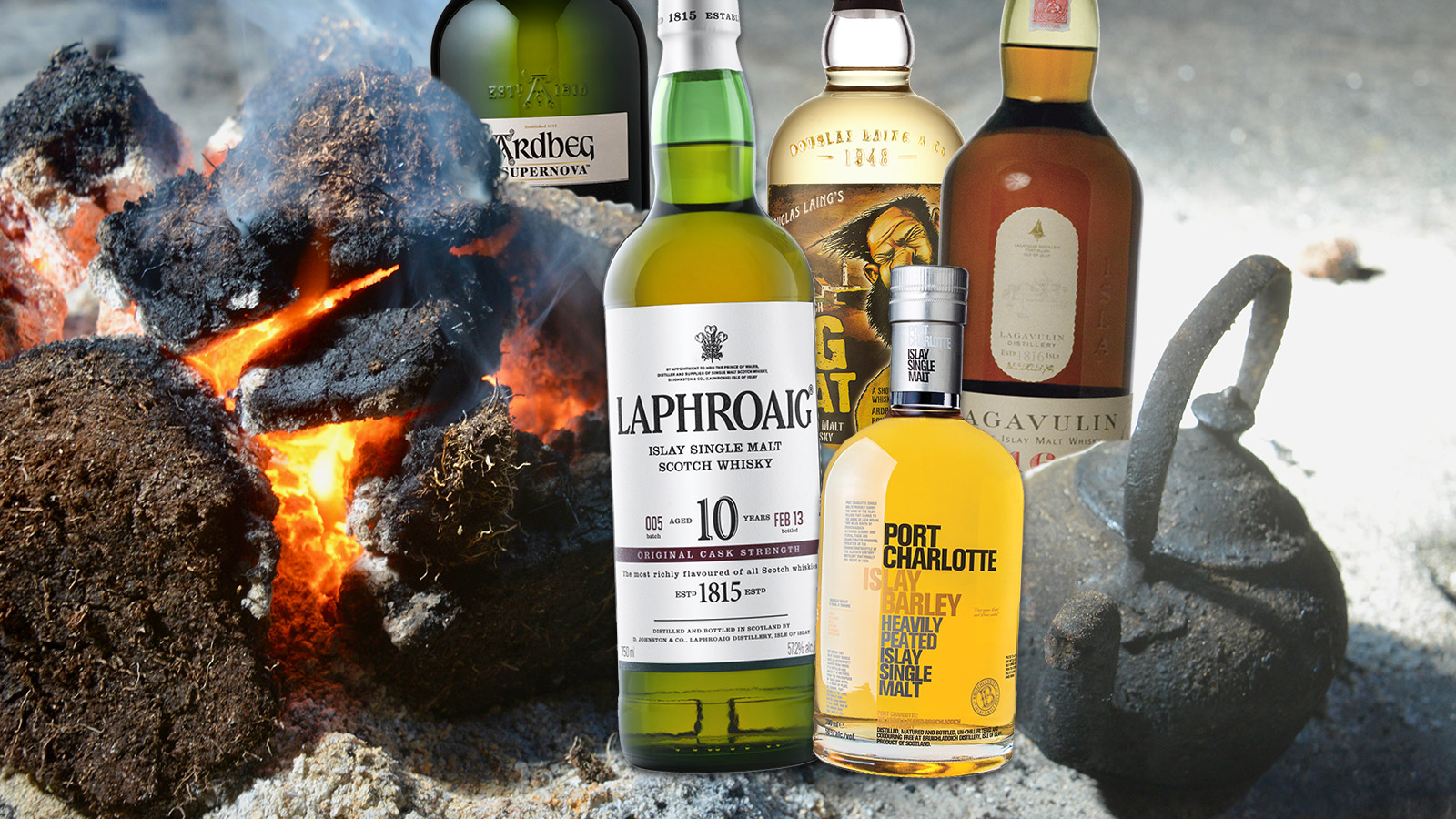
Islay whiskies have historically remained single malts and are generally well know for their peatiness. Aficionados worldwide definitely value this inimitable quality which has been the hallmark of the island’s whisky product into the mists of time, the abundance of peat being key to the development of the industry on the island in the first place. This love of the peaty quality of Islays has driven distilleries, actually produce sub-brands which are peatier yet than their usual product, such as Bruichladdich with OC3/Octomore. However, peatiness is a generalized rule of thumb and is definitely not the full story by a long shot.
In fact, two of the brands on the island, Bunnahabhain and Bruichladdich, are not peated.
Islay’s generally, though, are otherwise defined by their dryness, smokiness (principally Ardbeg) and a slight saltiness, which is hardly surprising in view of the island’s geographical location. Don’t think for one moment that Islay’s aren’t in any way subtle. They are.
They generally produce a complex suffusion of vanillas and toffee, citrus-y, mossy and sometimes floral notes.
It’s the complexity of Islay whiskies that endears them to the hearts of whisky drinkers worldwide.