

Ardbeg
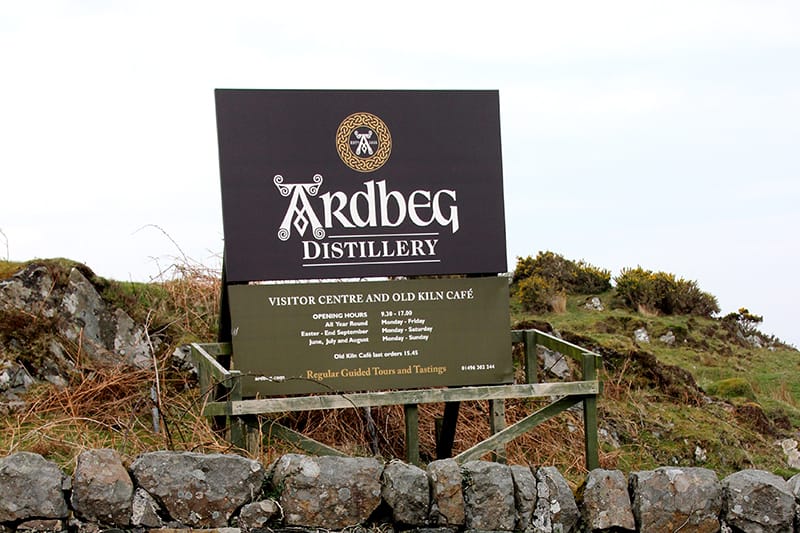
Ardbeg is a Anglicisation of the Scots' Gaelic '"An Àird Bheag" which translates as The Old Headland (or Promontory) and the Ardbeg. The distillery is known in Gaelic as ''Taigh-staile na h-Àirde Bige''. This is one of three distilleries on the Inner Hebridean island of Islay's southern side alongside Laphroaig, and Lagavulin and they are collectively known as the "Kildalton Distilleries'', Kildalton being the name of the ancient parish in which they are all situated. There was and will be a fourth distillery, Port Ellen, which closed in 1983 but which is actually being return back into operation by Diageo sometime soon
The Ardbeg story begins when an illegal distillery is founded on a singularly remote site set beside a small cove by Alexander Stewart in 1794. The site had long been a location for whisky smugglers to practice their art. Stewart's distillery was discovered by excisemen, shut down and the buildings demolished. However the subsequent tenants were as keen to distill whisky as the previous occupant had been and in 1798 Duncan McDougall, father of John and Alexander, rented out three farms on Islay: those of of Ardbeg, Airigh nam Beist and Ardenistiel, as well as half of the farmstead at Lagavulin and rebuilt the illegal operation which has recently been shut down. Commercial production of Ardbeg began 1815 when the company received a formal distilling license: a comparatively early one given that many whisky licenses were not given out until into the mid-to-late 1820s. Like most Scottish distilleries, for most of its history its whisky was produced for use in blended whisky, rather than for drinking as a single malt, although Ardbeg has distinguished itself by producing single malts throughout its development, albeit originally in small quantities.
In the late 1830s the 1840s, Alexander developed a severe problem with alcoholism which almost sunk the company, such that the company narrowly skirted having to close in 1838, when it was rescued by his spirit merchant, John Buchanan, who bought out the company for the sum of £1,000 but kept the MacDougalls in the day-to-day management. Alexander’s alcoholism meant that there was much smuggling of materials out of the plant by workers who would moonlight with their own distilling from their homes.
His two sisters, Flora and Margaret took on an increasing role in the day-to-day running of Ardbeg and they also brought in Colin Hay, who had been working there for some years, to see if they could set the company to rights. At this time, women engaging in business, let alone playing a part in running a distillery was very unusual indeed.
John died in 1853 and Flora in 1857 and the postmortem by Buchanan which followed revealed the dire state of affairs of the company’s finances, which has seen customers simply procure casks and walk away, never settling up for the whisky and there were also occasions where lawyer’s fees had been settled with whisky supply in lieu of cash. There had also been a tremendous amount of unwarranted profligacy which included extravagant spending on personal items and travel which included the cost of a passage to India and a wardrobe expressly bought for Dugald, Alexander’s brother who had since died.
Throughout the 1850s Colin Hay took a wider role in not only the day-to-day running of Ardbeg, first partnering with Margaret and then taking full control in 1865 after having reached a debt for equity agreement with Buchanan.
From then on the company went from strength to strength with the Hay family retaining overall control. Production reached an incredible one million litres and year in 1887 and the company trademarked its distinctive labelling with the unmistakable “A” on the label in 1911. Ardbeg was then taken over by the Lawson family in the 1920s. The company struggled through both world wars, depression, prohibition and the postwar austerity of the 1950s before being taken over by Distillers Company Limited and Hiram Walker in 1959.
In 1974 the Ardbeg closed down its own maltings, something that offended purists and instead contracted out the work to the nearby Port Ellen. In 1979 Hiram Walker bought out the DCL stake but the dire economic climate of the late 1970s in the UK and the devastation it caused in the whisky industry, in general, led to the closure of Ardbeg in 1981. The distillery remained closed for a long 8 years and in 1989 reopened as a unit within Allied Distillers (now Allied Domecq) who retained control until a 1997 takeover by Glenmorangie who invested heavily in the brand, opening a visitors’ centre and restaurant in 1998, coming out with a 10-year brand in 2000 and organising a highly successful campaign to promote Ardbeg across the globe. Glenmorangie was bought up by LVMH in 2005 and are the current owners.
Today’s Ardbeg is smokey and quite tarry but nevertheless extremely refined and relatively sweet. This unique taste derives partly from the fact that the malt goes through a long smoking and fermentation process at Port Ellen Ardbeg differentiates itself from the other Islay whiskies by utilising a purifier pipe set into the lynne arm of each still which balances and rarefies the constituent elements. It is medium-bodied, as are all the Islay Whiskies, replete with very distinct lime and lemon tones, although Ardbeg still sports that telltale Islay peatiness with a lot of the brine and iodine retained.
Ardbeg is a whisky of exceptional quality and distinctiveness. It can justifiably claim to be the most highly awarded smoky single malt whisky anywhere in the world and has been voted ‘World Whisky of the Year’ no less than four times in the last seven years.