

Ben Nevis
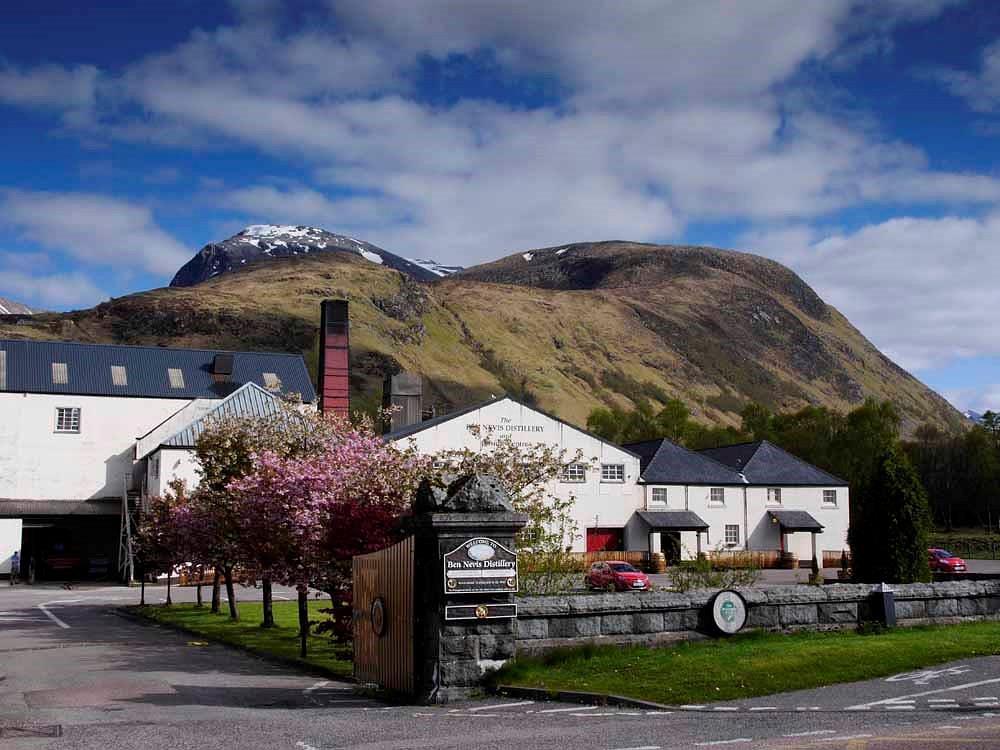
Ben Nevis distillery is located in Lochy Bridge in the Lochaber area of the Scottish Highlands, close by the River Lochy and near the foot of Ben Nevis mountain, Britain's highest peak at 1,345 metres (4,413 ft) above sea level. The distillery around 1.8 miles or just under 3 km due North East along the A82 road from the town of Fort William
Ben Nevis was ostensibly the brainchild ‘Long’ John Macdonald so called as he was 6 feet and four inches or 193 cm tall and, according to local legend and folklore, Macdonald had garnered extensive fame and notoriety as the local bootlegger of choice long before he went straight and gained a distilling license in 1825. This story is actually a bit off the mark, as, whatever John had to do with the development of Ben Nevis, the license was not actually taken out not by John, as the legend goes, but by his relative Angus Macdonnell. John did not actually become a formal partner in the distillery until 1830, although his expertise, garnered since childhood, might well have played extensively in the founding. In any event, John took up full control of Ben Nevis in 1831.
He has been distilling the brew on the family farm since childhood, which accounted for his uncanny ability in sampling and bringing in the best local barleys and peats to distil using the ultra-pure water source, the ”Allt a Mhuilinn” (millstream), sometimes known to Gaelic-speaking oldtimers in the area as the ”Allt Domhnall a t-Siùcair”, a stream (or ”sruth” in Gaelic) which originates from two pools, Coire Leis and Coire na Ciste on the slopes of Ben Nevis.
As well as his fame as a bootlegger prior to 1825, Long John, who could trace his ancestry back to Robert the Bruce, remains famous, amongst other things, for his chivalry and heroism: He is remembered for rescuing the Duchess of Buccleuch, one of the richest women in Britain and a lady in waiting to Queen Victoria who had strayed on Ben Nevis after dark on a misty evening in 1841. Long John ascended the mountain ringing a large handbell which enabled him to find the duchess and bring her to safety. John rescuing people on the mountain was actually quite a regular occurrence as particularly English well-heeled tourists tended not to understand the severity of the Highland weather and how quickly visibility could be lost and how the weather could turn in the area.
That year the distillery ostensibly counted both King William II of the Netherlands and Augustus Frederick, the Duke of Sussex, and only surviving son of George III and the King of Holland among its customers.
Queen Victoria herself had grown up as a keen devotee and connoisseur of Scotch Whisky and in 1848 ‘Long John’ MacDonald attempted to see if he could secure some demand and perhaps a royal warrant by sending a cask of Ben Nevis to the Royal Family on the occasion on the 21st birthday of the Prince of Wales. A royal warrant, sadly, did not materialise. However, all was not in vain and Long John did manage to secure a visit to the distillery from the Queen and Prince Albert in 1848 when they toured the Highlands, which obviously did a huge amount to publicise Ben Nevis whisky throughout Britain. This was also in that year that Victoria and Albert purchased Balmoral Castle and its huge 50,000-acre estate.
Long John was at once a superb distiller, an expert publicist and, as per many of the distillers, he was hit badly, both in terms of his own finances and those of the company, by the great Panic of 1847 and the ongoing banking crisis. The market for whisky also shrunk considerably and Macdonald sadly died bankrupt in 1856.
Long John’s name is something synonymous with not one but two whiskies. ”Long John Special Reserve” was originally brewed at Ben Nevis as a blended brand making use of malts both from the highlands and islands.
Long John was sold as a brand to Gin merchants W.H Chaplin in 1911, the year it incorporated malts from both the highlands and the islands, who retained it until 1927 when they were bought out by Seager Evans. A number of owners then followed as a result of takeovers including Whitbread, Allied Lyons and Allied Domecq until Chivas Brothers Holdings purchased the brand in 2005. Their current parent company is Paris-based Pernod Ricard and this particular blend, made from 48 malts, remains extremely popular not least in the French market.
Long John Special Reserve production began at Tormore Distillery site on Speyside in 1961 and so moved away from the Highlands.
It was left to John’s son, Donald to revive the fortunes of Ben Nevis which he rebranded ”Long John’s Dew of Ben Nevis” in the late 1800s. It was a pioneer single malt brand in an age where blended malts tended to dominate and were growing in popularity. Things went well and the distillery was expanded in 1878 with the opening of the ‘Nevis’ distillery which worked on auxiliary production. The site grew so fast that the two distilleries were amalgamated on-site in the early 1900s. The Nevis distillery was closed in 1908 following a downturn in the market and it remained vacant until WWII, being sold soon after, and the Ben Nevis site sputtered on and off for the first half of the 20th century as a result of WW1, the depression and prohibition.
The McDonald family actually remained in control of the Ben Nevis until well into the 20th century, in fact right until 2nd World War and 1941 when Ben Nevis was purchased by Canadian distiller, prohibition bootlegger (and well known eccentric) Joseph Hobbs, although distilling did not begin until 1955 when post-war rationing and austerity had ended in the UK. Hobbs died in 1964 and Ben Nevis was forced to close in 1978 due to the prolonged financial and fiscal crisis in the UK, the year of the Winter of Discontent. It was to remain closed for three years.
In 1981, the then Long John owners Whitbread purchased the Ben Nevis site, putting both the Ben Nevis single malt and the Long John blended malt under the same ownership once again for a brief period.
Ben Nevis Distillery was closed during the economic crisis of the late 80s for a further three years from 1986-1989 until it was purchased by the Nikka Whisky Co. of Japan to support their Japanese blending operations and until this day, some 50% of Ben Nevis‘ output is shipped off to Japan to be blended into Nikka’s Japanese product and then there are two blended whiskies made on site: Dew of Ben Nevis and also Macdonalds of Glencoe. However, in 1991 Nikka decided to open to reinvent and remarket Ben Nevis as a single malt.
So this is one of Scotland’s earliest single malt whiskies, one imbued with a proud and endearing history, a product that has, like so many single malts, somehow managed to endure by hook or by crook over the ensuing 200 or so years! It survives as a ruggedly exciting full-bodied and fruity blend and an exciting one, sought out by connoisseurs as an authentic reincarnation of a classic malt and replete with a ton of whisky history.