

Whisky. Where, When and How
Why is whisky called whisky? The term is actually an anglicisation of a Gaelic language word: ''uisge beatha'' or ''usquebaugh''. This is, in turn, a Gaelic take on the latin term ''Aqua vitae'' which translates into English as ''water of life''. Although the antecedents of distillation go almost to the beginnings of civilisation, let us first concentrate on how this singular drink which is whisky found its way to Scotland.
.
What's so incredible to contemplate is whisky's very long provenance in the country. To go into the origins of Whisky in Scotland it is probably necessary to venture all the way back across around 16 centuries to an ancient dark age kingdom! Whisky is intrinsically bound up with the customs, traditions, landscape and lifestyle of an ancient people and is inexorably bound up with the inimitable and haunting beauty of the Scottish landscape. It's the peaty quality of the earth in the glens and the wonderful purity of the spring water that flows into them which gives whisky its unique flavour.
The origins of the Scottish Gaelic language (and the most likely path that whisky took to arrive in Scotland) lie, though, just over the sea, across the North Channel, or ”Sruth na Maoile” in Gaelic (Moyle Stream), a very narrow strait (13 miles or 21 km across) which links the Irish Sea with the North Atlantic Ocean, a stretch of water which stretches from Torr Head in Northern Ireland to Scotland’s famed Mull of Kintyre.
In the 4th and 5th century AD there took place a migration of Irish clans across the North Channel from Ireland over to Scotland. The migrants formed a quite a powerful Celtic kingdom known as Dai Riata (Dairiade)and this loose kingdom consisting of four kindreds or dynasties straddled the Channel with just a small part of its territory located in what is now Northern Ireland (part of the current County Antrim) and the greater part of their land encompassing what is now broadly the Scottish county of Argyllshire.
A similar migration took place from Ireland to the Isle of Man (where the Manx language developed) and the Gaels also settled in North Wales and this has engendered a different pronunciation of Welsh from that in the south of Wales.
The area contains a plethora of islands, basically the southern part of the Inner Hebrides such as Iona, Arran, Islay, Jura and Colonsay. It was divided across the four kindreds or dynasties: the kindred of Cenél nGabráin (based in Kintyre), Cenél nÓengusa (based on Islay), Cenél Loairn (who gave their name to the district of Lorn on the mainland) and Cenél Comgaill (who gave their name to the Cowal peninsula). The capital was built the citadel at Dunadd, a hill fort at what is now Lochgilphead in Argyll and Bute, a place which can still be visited and explored today.
In fact ”Argyll” is itself an corruption of the Gaelic ‘Airer Goídel, which means ”Coast of the Gaels”. It was this kingdom which gradually expanded and became the Kingdom of Alba, still today the Scots Gaelic term for Scotland, into the 10th century.
Dai Riata means ”Riata’s portion” in Gaelic and to some commentators this indicates that the migration might have been led by a clan chief by the name of Riada or Riata, which is an Irish surname you’ll still find nowadays and which is mostly found in the Antrim area of Northern Ireland. In fact these origins are traceable back even further and are quite fascinating as they are alluded to by none other than Ptolemy himself in his 2nd century treatise ”Geography”. Riata, which means ”angry”, ”warlike” or ”full of rage” and in which territorial conquest seemed to play a major part: hence the expansion into Scotland. Riata seems to be bound up with the migrations of the Darini people.
The origins of these people in the region go far, far back: the Darini (Δαρῖνοι) were a people of ancient Ireland mentioned by now other than Ptolemy’s in the 2nd century as living in areas which correspond today to areas in Northern Ireland’s south Antrim and north Down. The name implies that its holders are the descendants of an ancestor called Dáire or Dārios. This ancestry is claimed by several historical peoples, including the Dál Riata and also the Dál Fiatach (Ulaidh) in the same area of eastern Ulster as well the Érainn (Iverni) of Munster. In fact a early name for the town of Dundrum, County Down was Dún Droma Dáirine, and the name Dáirine was also applied to the Érainn dynasty.
There are to this day Scottish and Irish clans who claim Darini lineage including the McMahons, McKenzies, Haugheys, Hoeys, McNulty’s, the McKinley’s of Dál Fiatach and the O’Driscolls and O’Learys of Corcu Loígde.
The Dal Riada was a Christian territory, a kingdom of some wealth and influence and a marine power to the extent that it had a powerful fleet if longboats. Its usefulness to Irish monks was that it also served as base for converting the Picts, who lived on the eastern side of Scotland, to Christianity. These proselytisers included St Columba and St Patrick and this fact is very important in how the story of Whisky is to play out as both are credited in folklore for bringing whisky to Scotland. Thus, it’s definitely a case of ”’follow the monk” both in terms of how ”whiskey” (note the spelling with respect to Irish Whiskey!) reached Ireland and then how ”whisky” (again note the spelling!) then reached the shores of Scotland.
Although we have no written evidence of the introduction of whisky into Ireland and to Scotland until 1170- for Ireland and 1494 for Scotland, it must be remembered that Patrick lived at around the time of the Anglo Saxon landings in England. We know that Aqua Vitae was known to Romans, Ancient Britons and also to the Anglo Saxons.
The folkloric story is that well distilling was brought by St Patrick from Ireland to the Dai Riata in 432 AD although there is a counter story that it was St Columba and his followers, just over a century later in 563 AD. Columba was himself an Ulster Gael who first landed in Kintyre and then was gifted Iona by the Dal Riata King Conall mac Comgaill.
When you realise that it’s St Patrick who is credited with bringing whisky not just to Scotland but to Ireland before that one realises that Whisky making in Scotland might well have even earlier origins in the British Isles. What’s certain is that barley had been grown in Ireland for 3,500 years and that bere (the local variety of Barley in Northern Scotland) has a history of cultivation of around 6,000 years.
Until at least them mid 1700’s, whisky was drunk as soon as it was distilled: Before the that time there was no ageing process. The whisky would have an extremely raw and bitter taste to the modern drinker.t he land’s crystal-clear springs, streams and burns.om the land’s crystal-clear springs, streams and St Patrick (who took the name Patricius or Patrick) was born with the name of Maewyn Succat in 387 in Bannavem Taburniae, known as Nemthur, and it’s only in the last few years that archaeologists and historians have finally figured where this was: Kilpatrick, near Dumbarton in Scotland. It was located by the Subdobianon Fort, one of seven forts that lined the Antonine wall or ”Vallum Antonini” in Latin. The wall , located between the Firth of Forth and the Firth of Clyde had been constructed by Hadrian in 142 AD to mark the Northwestern edge of the Roman Empire and protect the territory against marauding Caledonians. It postdates Hadrian’s wall, some 113 miles to the south, which was built in 122 AD, by some 20 years. Although they both etch a line from coast to coast across Scotland, the two walls are very different, as Hadrian’s Wall is all made of stone whereas the Antonine Wall has turf base. You can still visit both the Antonine Wall and Hadrian’s Wall which both remain as major an distinct features of the Scottish landscape.
Patrick himself spoke the ancient British language which to all extensive purposes is he precursor of today’s modern Welsh.
There are also a number of scholars who believe that whiskey was brought first to Ireland by Christian monks not by Patrick or Columba but at some juncture between the 8th and 11th centuries. Distillation had been practised by the Romans and the Arabs and we certainly have a record of Arab chemist Abu Musa Jabir ibn Hayyan experimenting with distillation around 800 AD. It’s quite possible that Monks from Celtic lands, who would often make long pilgrimages to the Mediterranean and Moorish regions may have discovered distilling at this time. Against this we know that, as mentioned Aqua Vitae was drunk throughout the Roman Empire so the stories of whisky’s earlier introduction to the British Isles are quite credible. Islamic culture was a repository for much classical knowledge and it’s quite possible that both Arab distillation and the distillation knowledge in Ireland and Scotland simply came down in a parallel fashion from Roman antecedents.
As previously mentioned, the first reference to whiskey in Ireland was in 1170. Shortly after his 1169 invasion of Ireland, Henry II, of England alluded to the Irish preference for preparing and drinking aqua vitae.
In Scotland, the first evidence of commercial whisky production comes almost 300 years later and it is to be found from an entry in the 1494 Exchequer Rolls for 1494 and describes the sending of malt “To Friar John Cor, by order of the king, to make aquavitae”, enough to make about 500 bottles. John Cor was the friar of Lindores Abbey in Fife and, again, Lindores, like so many of the places in the history of whisky, is still with us. In fact, they are still distilling whisky there after 523 years and the abbey can still be visited to this day.
Whisky distilling grew and it spread geographically over Scotland during the 15th, 16th and 17th centuries to the point where the Scottish government started to view it as a source of tax revenue. The first official taxes on whisky production were imposed in 1644. However the effects drove the whisky industry underground and the moves provoked a wave of illicit whisky distilling across the country.
Illegal distilling was not stamped out, either. By 1780, we know of eight legal distilleries but these were greatly outnumbered by some 400 illegal ones!
The importance of whisky and how it featured in the lives of the Highland Scots is something attested to in a recalling of a 1695 visit to the region by Hebridean author and traveller Martin Martin, a factor of the Macleod clan. Martin, a Gaelic speaker himself noted in his 1703 book ”A Description if the Western Islands of Scotland’ that the spirit. known as was used really only for medicinal purposes and not as a drink of leisure at the time. Martin writes of the raw just-distilled whisky: ”Two spoonfuls of this last liquor, is a sufficient dose, and if any man exceed this, it would presently stop his breath” Martin also details that there the common whisky was brewed twice over, known as ”usquebaugh” or three times, know as ”trestarig” or four times which produced ”usquebaugh baul” or the ”hazardous spirit”!
Governments had long seen taxing whisking distilling as either a problem or a source of revenue! In fact 1597 the Scottish parliament actually tried to restrict whisky distillation entirely. It was all but ignored. In 1644 an excise duty was introduced at a fairly hefty 2 shillings and 8 pennies per Scots pint (known in the vernacular as a ”joug’ and equal to about 1.7 liters) of aqua vitae or any other strong liquor but there weren’t the means to collect around what was largely an illicit trade!
The introduction of this tax simply added to the long and colourful tradition of smuggling, and the practice of home-distilling continued regardless with small stills producing smooth malt whiskies which could be sold to passing cattle drovers, and the large scale producers making spirit for the London markets. No doubt Coinneach Odhar, the Brahan Seer, must have had this in mind in the mid-seventeenth century when he prophesied that:”The time will come when dram shops will be so plentiful that one may be seen at the head of every plough furrow.”
Before the 1707 Acts of Union whereby James the 6th of Scotland acceded to the English crown and Scotland, England and Ireland, Whiskey was made by almost every farmer in Scotland but it hadn’t been really discovered either in England or overseas and remained a parochial cottage industry.
Whisky was a tricky subject as the new Westminster government of England and Scotland, so of Great Britain (it was not called the United Kingdom until the 1801 Act of Union with Ireland), saw it as a revenue source but to tax whisky distilling in Scotland was initially considered as imprudent, so there was initially a tax on malt in England from which Scotland was exempt!
Westminster attempted to tax distilling again in 1713 but once more vehement opposition north of the border managed to win a reprieve. Then in 1725 the government of Sir Robert Walpole managed to push through legislation that finally taxed malt distilling in Scotland. The were two results: widespread rioting in the streets of major towns and cities and a wholesale outbreak of whisky smuggling. The smugglers were held as heroes by the local populace and the exciseman vilified to the extent that Dr Samuel Johnson named them as “wretches, hired by those to whom excise is paid.” (!) The taxing of distillation floundered, however, especially in the years after the Jacobite rebellion of 1745. Thereafter, whisky making began to extend from the Highlands of Scotland into the Lowlands.
Whisky distilling was a vital way for the lower orders in Scotland to make a living. The period of 1750-1860 was the time of what is known as ”The Clearances”. These were evictions by Highland and Island land owners, often deeply in debt themselves, and involved the displacement of what was known as ”crofters’, essentially peasant farmers who tenanted their land from the landowners. The population (many of which emigrated peopled countries such as Canada, the United States and Australia) were often forced into distilling (or smuggling) as it was their own way of earning a living.
At this time, whisky was still very much the drink of the lower orders of society. For the upper classes, the acceptable drinks were claret, port, rum, hock. Whisky was invariably home brewed by the poor and was often drunk as part of a ”toddy” which was a drink that combined sugar, hot water and whisky. – the combination of whisky, sugar and hot water – was a common drink, whereas the great houses served claret and hock, possibly brandy, rum, port and ”hock”, a shortening of the word Hockamore which an anglicised take on Hochheimer, so basically a Hockenheim Riesling. In the 1700s the drink of choice in society London was gin and the 18th century is a long story of how whisky began to gradually displace gin as the drink of choice.
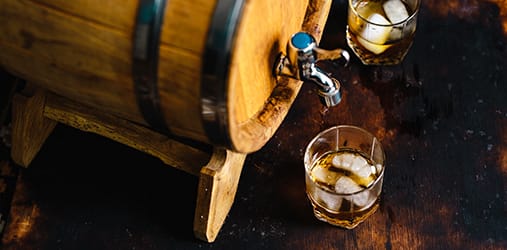
About 50 years after the Acts of Union a major shift took place in the production of whisky: it began to be aged in casks and people were realising through experience that the longer the whisky was stored in a cask or barrel, the better it tasted.
To get an idea of the ratio of legal to illicit distilling of whisky in Scotland, we know that Edinburgh in 1777 had 8 legal distilleries and was reputed to have around 400 illicit ones!
By the early 1800s with the passing of the 1816 Small Stills Act, licensing stills with a maximum capacity of 40 gallons, things had tightened up but not that much: an 1822 report from Britain’s Inland Revenue mentions that “Illicit distilling is so widespread that half the spirits actually consumed are supplied by smugglers.” (!)
By the 1820s, we know that as many as 14,000 illicit stills were being confiscated every year but that this was only the tip of the iceberg!
A key event happened in the year 1823 when the Westminster Parliament passed the Excise Act which both formalised and lightened the tax regime apropos licensed distilleries. The act also contained clauses that enabled a clampdown on illegal distilling and the current ecosystem of the Scotch Whiskey industry can really be said to have emerged from this time.
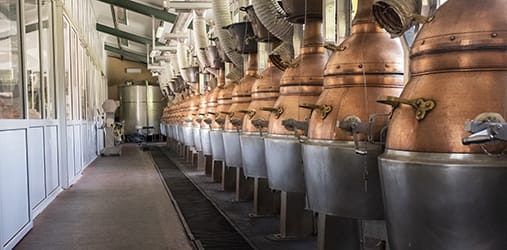
In 1830, a development which takes place which serves to give Whiskey at least some of the the smoothness and subtlety with which we associated it today, namely the introduction of the ”Patent still” or ”Coffey” for its inventor, the Irishman Aeneas Coffey. Coffey refined a series of inventions that had begun with a process initiated by Napoleon who wanted to reduce the reliance of French wine distillers on British-made stills. The French stills were ideal for wine-making but not so good for whisky and, although there were various developers in England, Scotland, Germany and elsewhere, it was Coffey’s still (sometimes also referred to as a column still), which took hold. The company is still producing its stills today as John Dore and Co. Ltd.
Another key shift occurs when a blight take place in France in the 1860’s which wiped out Cognac supplies throughout Europe. Essentially it began when French vintners began importing American vines which were infested with the Phylloxera bugs. European aristocrats and the wealthy merchant classes substituted cognac with sherry and soon Europe was home to a growing repository of sherry casks and Scottish distillers began purchasing the expanding surplus in which to age their whiskies. Sherry demand was particularly high in England and so it was possible to ship the casks by rail up from London and the other large English metropolitan centres. By the way, these are not the solera casks in which the sherry aged: these are specifically shipping casks specifically constructed for the delivery of the product from Jerez to overseas markets.
Whisky exportation followed the British Empire throughout the 19th and 20th centuries but the aforementioned phylloxera blight in France decimated supplies of Brandy in particular and Europeans often moved to whisky as a more available alternative. The momentum for whisky in the US was brought about to a large extent by prohibition and by the fact that whisky was permitted at drugstores on prescription as a medicine throughout the period 1920-33. The US is the largest global market for Scotch whisky although the top per capita consumption is actually France. Otherwise whisky aficionado nations are Uruguay, Australia, Spain, India and Japan. Asian markets outside of India have also seen rapid growth in recent years. However, supply of whisky is actually quite limited. Scotland only has 130 working distilleries.
So there, in a nutshell, is something of the history of whisky over the last one thousand six hundred or so years. There are obviously more stories and more leads to follow up but the hope is that you now have a much better notion of the land, the people, the culture and the antecedents of the world’s beloved spirit.